
If you’re determined to add serious inches to your vertical, this guide delivers a complete, science-backed roadmap to get you there. Many athletes train relentlessly yet hit frustrating plateaus because their programs prioritize volume over proven principles. Here, you’ll learn how biomechanics, strength development, and explosive plyometrics work together to produce measurable gains. We break down the exact strength lifts, reactive drills, and vertical jump technique tips that translate raw power into real height. Every recommendation is grounded in established performance science, giving you a clear, actionable path to unlock your true explosive potential.
The Anatomy of a Jump: Understanding the Core Mechanics
The jump looks simple, but I’ve learned the hard way it’s a three-phase dance. First comes the eccentric, or loading, phase: you dip and rapidly stretch the muscles. Then the amortization phase, a split-second transition where hesitation kills height. Finally, the concentric explosion, where stored energy fires you upward.
Early on, I focused only on squatting heavier. After all, strength equals power, right? Not quite. The real driver is the Stretch-Shortening Cycle (SSC), which pairs a rapid stretch with an immediate contraction, like snapping a rubber band. When my transition lagged, I leaked force. However, once I shortened that pause, my vertical jump climbed.
Key muscle groups matter, too. The glutes, quads, and hamstrings drive the lift, while the core stabilizes and the calves and shoulders finish the job. Yet strength alone isn’t enough. You must apply force quickly—force divided by time defines power.
In hindsight, rushing heavy lifts without mastering timing stalled me. Study proven vertical jump technique tips, prioritize crisp transitions, and train explosively. That’s when height finally follows. Remember to rehearse quick, controlled dips and land softly to recycle energy efficiently every single rep. Quality beats ego lifting.
Building the Engine: Foundational Strength for Explosive Power
If you want a higher vertical, you need a higher strength ceiling. Think of strength as your engine size. A bigger engine produces more FORCE. And more force potential = higher jump potential. It’s basic physics: power is force applied quickly (NSCA Essentials of Strength Training & Conditioning).
Some argue plyometrics alone are enough. Sure, box jumps look flashy (very Instagram-ready). But without raw strength underneath, you’re just rehearsing a small jump—over and over. BUILD THE BASE first.
Essential Compound Lifts
1. Barbell Back Squats
Why: Deep squats train force production through full hip and knee flexion, building power “out of the hole.”
How:
- Descend below parallel with control
- Drive up explosively
- Keep chest tall and knees tracking over toes
2. Deadlifts (Conventional or Trap Bar)
Why: Unmatched for posterior chain development—glutes and hamstrings are your jump engines (Journal of Strength and Conditioning Research).
How:
- Push through midfoot
- Lock out hips hard
- Maintain a neutral spine
3. Overhead Press
Why: Strong shoulders and core improve arm swing transfer.
How:
- Brace abs
- Press straight overhead
- Avoid leaning back
Programming for Strength
Prioritize low reps, heavy weight:
- 4–5 sets
- 3–6 reps
- 2–3 minutes rest
This rep range targets MAX STRENGTH over size (ACSM guidelines).
Pro tip: Add vertical jump technique tips after heavy sets to reinforce speed while fresh.
Strength isn’t optional. It’s the FOUNDATION. Build it, and your explosiveness has somewhere to go.
From Strong to Explosive: Mastering Plyometric Training
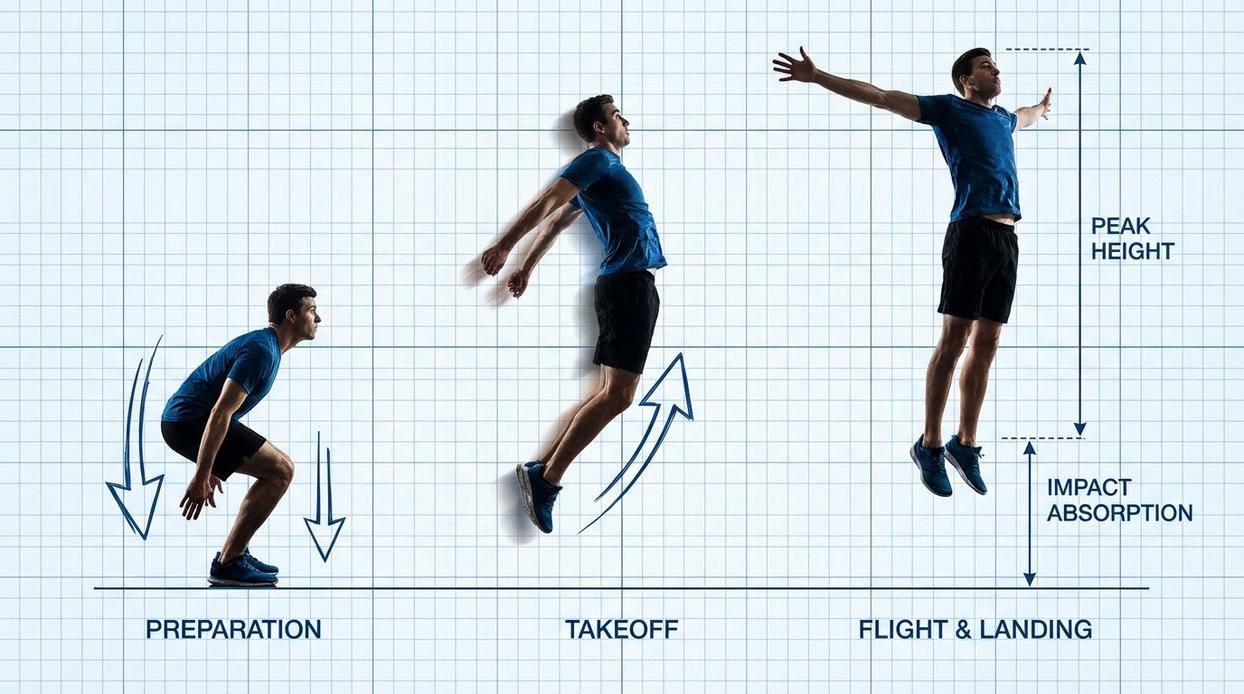
Strength is impressive. Speed is flashy. But power—the ability to express strength quickly—is what separates good from explosive.
Plyometrics is the method that bridges that gap. It trains the Stretch-Shortening Cycle (SSC), a rapid muscle action where a muscle lengthens (eccentric phase) before immediately shortening (concentric phase). Think of it like pulling back a slingshot before release. The faster and more efficiently you transition, the greater the force output.
Some argue heavy lifting alone builds enough explosiveness. And yes, strength is foundational. But without training rapid force absorption and redirection, you’re strong in slow motion. Plyometrics teach the body to minimize ground contact time—absorbing force and redirecting it almost instantly (like a basketball player grabbing a rebound and going straight back up).
A Progressive Approach to Plyometrics
-
Foundational Drills:
-
Box Jumps (focus on landing softly and controlled).
-
Broad Jumps for horizontal power development.
-
Intermediate Drills:
-
Depth Jumps—often called the ultimate SSC developer.
-
Hurdle Hops to sharpen reactive strength.
Quality beats quantity every time. Perform each rep with maximal intent and take full recovery between sets. Fatigue kills explosiveness—and increases injury risk.
You might now be wondering: what’s next? Dial in vertical jump technique tips, prioritize mobility, and don’t ignore recovery. For deeper strategies, explore this in depth look at recovery protocols used by professional athletes.
Train smart now so your next jump, sprint, or lift isn’t just strong—it’s explosive.
Fine-Tuning the Ascent: Technique, Mobility, and Recovery
I still remember the first time I added two inches to my vertical almost overnight. It wasn’t a new program. It was my arms. Once I learned that an aggressive, synchronized arm swing can boost jump height by 10–15% (Harman et al., 1990), everything clicked. The arm swing is the coordinated backward-to-forward drive of the arms during takeoff, helping generate upward momentum (think of how a superhero launches—dramatic, deliberate, explosive).
Then there’s the penultimate step—the second-to-last step before a two-foot takeoff. Its job is to lower your center of gravity (your body’s balance point) so you can redirect force vertically. Done right, it feels smooth and springy. Done wrong, it feels like jumping in sand.
Mobility is the silent limiter. Tight hips and stiff ankles block proper loading and force transfer. Try:
- Deep squat holds (30–60 seconds)
- Ankle rockers against a wall
Some argue strength alone determines jump height. I used to believe that, too. But without mobility and refined vertical jump technique tips, strength leaks away.
Finally, recovery isn’t optional. Sleep supports muscle repair and nervous system reset (Walker, 2017). Nutrition fuels adaptation. Pro tip: prioritize 7–9 hours nightly. Your legs will thank you.
A Blueprint for Your New Vertical
You came here for a clear, actionable plan to increase your vertical jump—and now you have it. By combining strength development, explosive plyometrics, and vertical jump technique tips, you’re no longer guessing your way through workouts. You understand that random exercises create random results, and that frustration ends with structure.
A systematic approach is what turns effort into measurable progress. Build your strength base. Convert it into power. Refine your mechanics. Repeat.
Now take action: pick one strength move and one plyometric drill to add to your training this week. If you’re ready to stop spinning your wheels and start seeing real elevation gains, follow our proven performance strategies and commit today.