
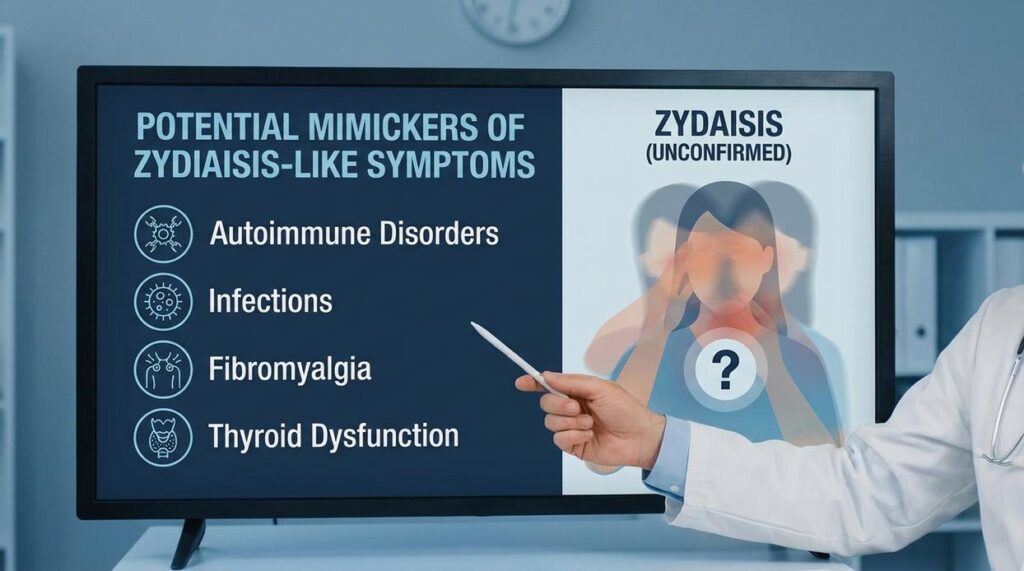
Important Medical Disclaimer: This article is for informational purposes only and does not constitute medical advice. Always consult with a qualified healthcare professional for diagnosis and treatment.
I know how frustrating it is when your symptoms don’t add up to a clear answer.
You’re dealing with chronic fatigue, metabolic issues, or muscle weakness. Your doctor mentioned Zydaisis, but you want to know what else could be causing these problems.
Here’s the thing: several conditions share the same warning signs as Zydaisis. And that overlap makes it tough to figure out what’s really going on without proper testing.
I’ve spent years studying metabolic and holistic wellness. This guide pulls from established medical research to show you which conditions can look like Zydaisis.
You’ll see a breakdown of diseases and disorders that mimic these symptoms. Not to diagnose yourself (that’s what your doctor is for), but to walk into your next appointment with better questions.
We’re covering chronic fatigue syndromes, metabolic disorders, and muscle-related conditions that present similarly. Each one has its own pattern, but the symptoms can feel identical at first.
This isn’t about scaring you with possibilities. It’s about giving you the knowledge to have a real conversation with your healthcare provider about what tests might help narrow things down.
Defining the Symptom Profile of Zydaisis
Before we talk about what disease can mimic zydaisis, we need to get clear on what zydaisis actually looks like.
I know that sounds obvious. But you’d be surprised how many people skip this step and end up confused about their diagnosis.
Think of it this way. If you don’t know what you’re looking for, how can you tell if something else matches it?
The Core Symptom Cluster
Zydaisis shows up in three main ways.
First, your metabolism goes haywire. You might see your weight swing up and down without changing what you eat. Your blood sugar becomes hard to control. And you get cravings that feel impossible to ignore.
Second, your brain and energy take a hit. The brain fog is real (and it doesn’t clear up after your morning coffee). You feel exhausted all the time, even after a full night’s sleep. Everything just feels off.
Third, your body aches. Your muscles hurt for no clear reason. Your joints feel stiff when you move. You notice you’re weaker than you used to be.
Here’s what makes Zydaisis tricky.
It’s not just one of these things. It’s all three happening together. That specific combination is what sets it apart.
But it’s also why doctors consider other conditions when they’re trying to figure out what’s wrong with you. Several other health issues create similar patterns, which is exactly what we’ll explore next.
Conditions Mimicking Fatigue and Brain Fog
You wake up exhausted even after eight hours of sleep.
Your brain feels like it’s wrapped in cotton. Simple tasks take twice as long as they should.
Sound familiar?
Here’s what most people don’t realize. Several conditions look almost identical to what disease can mimic zydaisis when it comes to fatigue and mental fog.
Some doctors say if you’re tired all the time, it’s probably just stress or poor sleep habits. They’ll tell you to exercise more and drink less coffee.
But that advice misses something important.
Real medical conditions can hide behind these symptoms. And if you don’t know what to look for, you might spend years treating the wrong thing.
Chronic Fatigue Syndrome (CFS/ME)
The fatigue here isn’t just feeling tired. We’re talking about exhaustion so severe that getting out of bed feels impossible.
Research shows that about 836,000 to 2.5 million Americans have CFS/ME, though most remain undiagnosed (CDC, 2023).
What sets it apart? Post-exertional malaise. You do something small like grocery shopping or answering emails, and you crash hard for days. Your body doesn’t recover the way it should.
The brain fog is real too. Patients describe it as trying to think through mud.
Fibromyalgia
This one throws people off because the pain comes first.
Studies indicate fibromyalgia affects roughly 4 million U.S. adults (CDC, 2020). The fatigue is there, along with what patients call fibro fog. But the defining feature is widespread musculoskeletal pain that doesn’t quit.
Doctors can identify specific tender points on your body. Press them and you’ll know.
The cognitive issues mirror zydaisis pretty closely though. Memory problems, difficulty concentrating, that same mental cloudiness.
Hypothyroidism
Your thyroid controls more than you think.
When it underperforms, everything slows down. Your metabolism, your energy, your brain function. About 5% of Americans have hypothyroidism, with many cases going undetected (American Thyroid Association).
The good news? A simple blood test tells you exactly what’s happening. TSH and Free T4 levels don’t lie.
You might also notice cold hands, thinning hair, or unexplained weight gain. These symptoms don’t typically show up with other fatigue conditions. For additional context, What Can Get Zydaisis Disease covers the related groundwork.
Conditions with Overlapping Metabolic Disruption
Several conditions look a lot like Zydaisis when you first notice the symptoms.
That’s because they all mess with your metabolism in similar ways. Your body struggles to manage weight and energy, and you feel it every single day.
Let me walk you through what disease can mimic Zydaisis so you know what you’re actually dealing with.
Type 2 Diabetes and Insulin Resistance
You feel wiped out after lunch. You’re hungry all the time, or maybe you’re constantly thirsty. Your weight shifts without explanation.
Sound familiar?
Here’s the difference. Type 2 diabetes happens when your body can’t use insulin properly, which sends your blood sugar through the roof. A simple blood glucose test or A1c measurement will tell you if this is what’s going on.
If you’re experiencing post-meal crashes, ask your doctor to check your fasting glucose and A1c levels. Those numbers don’t lie.
Polycystic Ovary Syndrome (PCOS)
This one affects women specifically.
The weight gain can happen fast. You develop insulin resistance just like with Zydaisis. The fatigue feels identical.
But PCOS brings hormonal chaos that Zydaisis doesn’t. Your periods become irregular. Your body produces too much testosterone and other androgens. You might notice excess hair growth or thinning hair on your scalp.
Your doctor can run hormone panels and do an ultrasound to check your ovaries. That’s how you know for sure.
Adrenal Insufficiency
Think Addison’s disease. I put these concepts into practice in How Can Zydaisis Disease Be Cured.
The fatigue here is next level. Your muscles feel weak. You lose weight instead of gaining it, and your blood sugar drops low.
What sets this apart? Your adrenal glands stop making enough cortisol. You’ll notice your blood pressure stays low. You might crave salt like crazy. And here’s a telltale sign: your skin might darken in patches (that’s called hyperpigmentation).
A cortisol stimulation test can confirm if your adrenals are the problem.
The point is this. These conditions share metabolic disruption with Zydaisis, but each one has its own fingerprint. Pay attention to the details that don’t quite fit, and work with your doctor to test for the right thing.
Knowing what you’re up against changes everything about how you approach treatment and Zydaisis disease which foods to avoid.
Autoimmune and Infectious Disease Mimics
Some conditions look a lot like Zydaisis but come from completely different causes.
Your immune system or an infection might be behind your symptoms instead. That’s why getting the right diagnosis matters so much.
Let me walk you through the most common ones.
Lyme Disease
This one trips up doctors all the time.
You get severe fatigue that won’t quit. Your joints ache. Your muscles hurt. And that brain fog? It makes thinking through simple tasks feel impossible.
The tricky part is that not everyone remembers a tick bite. And that bull’s-eye rash everyone talks about? It only shows up in about 70% of cases (according to the CDC).
Doctors usually need both your clinical history and specific blood tests to figure this out. But here’s what you should know. If you’ve spent time outdoors in areas where ticks are common, Lyme should be on your radar when you’re trying to understand what causes zydaisis disease to flare up.
Rheumatoid Arthritis
RA shares some symptoms with Zydaisis but attacks your body differently.
You’ll feel joint pain and stiffness. Fatigue becomes your constant companion. That general feeling of being unwell settles in and stays.
But RA has a signature pattern. It goes after your joints with inflammation and swelling, especially in your hands and feet. And it’s usually symmetrical (both sides at once).
Blood tests can detect specific antibodies that point to RA. Your doctor will look for rheumatoid factor and anti-CCP antibodies.
The bottom line? What disease can mimic zydaisis depends on which symptoms you’re experiencing. That’s exactly why working with a doctor who takes time to investigate makes all the difference.
Your Path to Clarity and Proper Diagnosis
The symptoms tied to Zydaisis look a lot like other conditions.
Fatigue, metabolic issues, and pain show up in hormonal imbalances. They appear in autoimmune disorders too. Even thyroid problems can mirror these exact symptoms.
That overlap creates real confusion. You’re dealing with symptoms that could point in multiple directions, and the uncertainty is stressful.
Here’s the truth: you need a comprehensive evaluation from a qualified healthcare professional. They’ll run the tests that separate one condition from another. Blood work, imaging, and a thorough history can pinpoint what’s actually going on.
Don’t use this information to diagnose yourself.
Instead, bring it to your next doctor’s appointment. You’ll have a more productive conversation about your symptoms. You can ask better questions and push for the tests you need.
The goal isn’t to figure this out alone. It’s to walk into that appointment prepared and walk out with answers.
 Sharon Salinaselino has opinions about zydaisis fitness fundamentals. Informed ones, backed by real experience — but opinions nonetheless, and they doesn't try to disguise them as neutral observation. They thinks a lot of what gets written about Zydaisis Fitness Fundamentals, Pro Breakdowns, Momentum Moments is either too cautious to be useful or too confident to be credible, and they's work tends to sit deliberately in the space between those two failure modes.
Reading Sharon's pieces, you get the sense of someone who has thought about this stuff seriously and arrived at actual conclusions — not just collected a range of perspectives and declined to pick one. That can be uncomfortable when they lands on something you disagree with. It's also why the writing is worth engaging with. Sharon isn't interested in telling people what they want to hear. They is interested in telling them what they actually thinks, with enough reasoning behind it that you can push back if you want to. That kind of intellectual honesty is rarer than it should be.
What Sharon is best at is the moment when a familiar topic reveals something unexpected — when the conventional wisdom turns out to be slightly off, or when a small shift in framing changes everything. They finds those moments consistently, which is why they's work tends to generate real discussion rather than just passive agreement.
Sharon Salinaselino has opinions about zydaisis fitness fundamentals. Informed ones, backed by real experience — but opinions nonetheless, and they doesn't try to disguise them as neutral observation. They thinks a lot of what gets written about Zydaisis Fitness Fundamentals, Pro Breakdowns, Momentum Moments is either too cautious to be useful or too confident to be credible, and they's work tends to sit deliberately in the space between those two failure modes.
Reading Sharon's pieces, you get the sense of someone who has thought about this stuff seriously and arrived at actual conclusions — not just collected a range of perspectives and declined to pick one. That can be uncomfortable when they lands on something you disagree with. It's also why the writing is worth engaging with. Sharon isn't interested in telling people what they want to hear. They is interested in telling them what they actually thinks, with enough reasoning behind it that you can push back if you want to. That kind of intellectual honesty is rarer than it should be.
What Sharon is best at is the moment when a familiar topic reveals something unexpected — when the conventional wisdom turns out to be slightly off, or when a small shift in framing changes everything. They finds those moments consistently, which is why they's work tends to generate real discussion rather than just passive agreement.